Have you ever asked someone a question and received a response that felt cold, uninterested, or completely emotionless? Maybe you shared exciting news and they simply shrugged and said, “Okay.” In moments like these, people often describe that reaction as indifferent.
The word indifferent is common in everyday conversations, social media discussions, relationships, and even workplace settings. Yet many people misunderstand what it truly means.
Based on years of observing online communication trends and language usage, understanding words like indifferent can help you better interpret people’s attitudes and emotions.
What Does Indifferent Mean? (Direct Answer)
What Does Indifferent Mean?
Indifferent means showing little or no interest, concern, excitement, or emotional involvement in something. When a person is indifferent, they do not strongly care about the outcome of a situation and may appear neutral, unconcerned, or emotionally detached from what is happening around them.
Meaning & Definition
At its core, the word indifferent describes a lack of strong feelings.
Primary Meaning
A person is indifferent when they do not care much about something or do not have a preference.
Example:
- “I’m indifferent about which movie we watch.”
- “She seemed indifferent to the argument.”
Secondary Meanings
In some situations, indifferent can mean:
- Neutral between two choices
- Emotionally detached
- Uninterested or unconcerned
- Neither positive nor negative
Real Chat Examples
Friend 1: “Do you want pizza or burgers?”
Friend 2: “I’m indifferent. Either one is fine.”
Person A: “Did you hear about the office changes?”
Person B: “Honestly, I’m pretty indifferent about it.”
Background & Origin
The word indifferent comes from the Latin word indifferens, which means “not different” or “making no distinction.”
It entered the English language centuries ago and originally described situations where there was no preference between options.
Over time, its meaning expanded to include emotional neutrality or lack of concern.
Today, people use it frequently in:
- Everyday conversations
- Social media posts
- Relationship discussions
- Workplace communication
Usage in Different Contexts
Casual Chats
In daily conversations, indifferent usually means someone does not mind either option.
Example:
“I’m indifferent about where we eat tonight.”
Social Media
People use indifferent when discussing trends, celebrity news, or viral topics.
Example:
“Everyone is talking about this trend, but I’m indifferent.”
Professional Use
In workplaces, the word can describe a neutral attitude toward a proposal or decision.
Example:
“The team remained indifferent to the suggested changes.”
Gaming & Group Chats
Gamers may use indifferent when they do not care which game mode or strategy is chosen.
Example:
“I’m indifferent. Pick whatever map you want.”
Meanings Across Platforms
| Platform | Tone | Example |
| Casual | “I’m indifferent, you decide.” | |
| Neutral | “Honestly indifferent about this trend.” | |
| TikTok | Slightly sarcastic | “Everyone’s obsessed, I’m indifferent.” |
| Snapchat | Informal | “Kinda indifferent tbh.” |
| Discord | Relaxed | “I’m indifferent about the next game.” |
Real-Life Examples & Memes
Chat Examples
Friend: “Do you like the new logo?”
You: “I’m indifferent. It looks okay.”
Friend: “Should we go out tonight?”
You: “I’m indifferent. Whatever works.”
Meme-Style Lines
- “Everyone: Fighting online. Me: Completely indifferent.”
- “When drama starts but you’re emotionally on airplane mode.”
Cultural or Regional Interpretations
United States & United Kingdom
People often use indifferent to describe neutrality or emotional distance.
India, Pakistan, and the Philippines
The word is frequently associated with not caring about a topic or being unconcerned about a decision.
Australia
Australians may use indifferent casually when they have no strong preference between options.
Other Meanings
| Field | Meaning | Description |
| Psychology | Emotional detachment | Limited emotional response |
| Relationships | Lack of interest | Not emotionally invested |
| Business | Neutral stance | No strong support or opposition |
| Economics | Equal preference | No difference between choices |
| Daily Communication | Unconcerned attitude | Little interest or care |
Common Mistakes & Misconceptions
- Thinking indifferent always means rude.
- Assuming indifferent means angry.
- Believing it always reflects negative feelings.
- Confusing indifferent with being lazy.
- Assuming someone who is indifferent dislikes something.
Psychological / Emotional Meaning
Positive
Sometimes indifference can help people stay calm and objective.
Neutral
Most often, it simply means having no strong feelings.
Negative
In relationships, indifference can feel hurtful because it may suggest emotional distance.
Similar Terms & Alternatives
| Word | Meaning | Tone |
| Neutral | Not taking sides | Neutral |
| Unconcerned | Not worried | Mildly negative |
| Detached | Emotionally distant | Negative |
| Apathetic | Lacking interest | Strongly negative |
| Unbiased | Fair and objective | Positive |
Is It Offensive or Friendly?
The word itself is not offensive.
However, context matters.
Friendly Example
“I’m indifferent about the restaurant. You choose.”
Potentially Hurtful Example
“I told him about my promotion and he seemed indifferent.”
In the second example, the lack of enthusiasm may feel disappointing.
Grammar or Linguistic Insight
Indifferent is an adjective.
It describes a person’s attitude, feelings, or reaction.
Examples:
- She is indifferent.
- They seemed indifferent.
- He remained indifferent throughout the discussion.
Related forms:
- Indifference (noun)
- Indifferently (adverb)
How to Respond When Someone Says They’re Indifferent
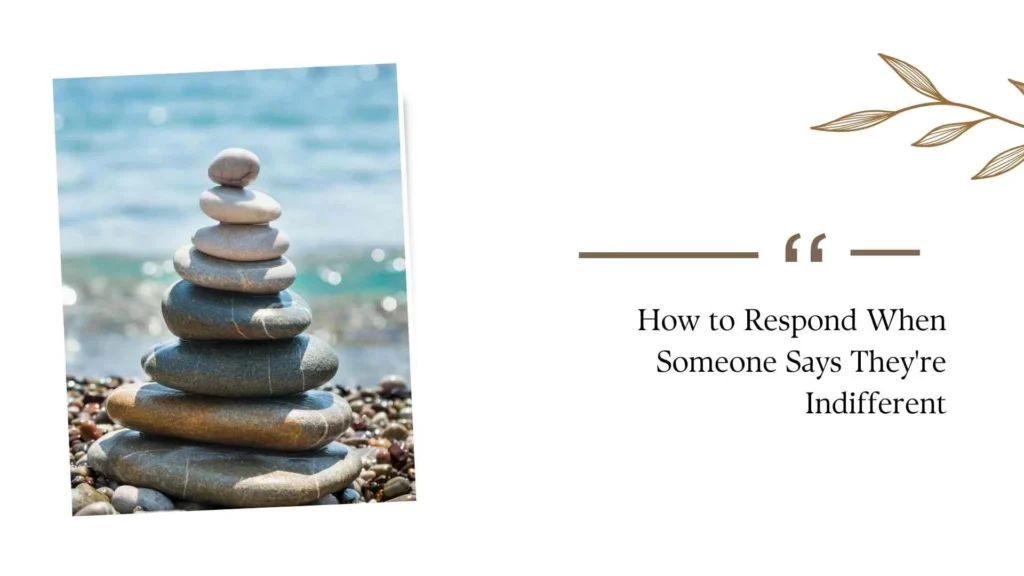
Here are some natural responses:
- “Okay, I’ll decide then.”
- “Either option works for you?”
- “Good to know.”
- “Thanks for being flexible.”
- “I’ll pick what’s best.”
Differences From Similar Words
| Word | Difference From Indifferent |
| Neutral | More balanced and objective |
| Apathetic | Stronger lack of interest |
| Detached | Emotionally removed |
| Unconcerned | Not worried specifically |
| Flexible | Willing to adapt rather than not caring |
Relevance in Dating & Online Culture
In dating, being indifferent can send mixed signals.
For example:
- Responding with short messages
- Showing little enthusiasm
- Not expressing preferences
On apps like Tinder, people may interpret indifference as:
- Lack of attraction
- Emotional distance
- Casual interest
Gen Z often discusses indifference in terms of emotional energy and relationship dynamics.
Popularity & Trends
The word indifferent continues to appear in:
- TikTok relationship videos
- Dating advice content
- Mental health discussions
- Meme culture
- Social media debates
Many creators use it when discussing emotional boundaries, self-protection, or relationship behavior.
When NOT to Use Indifferent
Avoid using indifferent in situations that require empathy or emotional support.
Examples
- When someone shares sad news
- During serious workplace discussions
- In customer service interactions
- During relationship conflicts
- When offering condolences
Saying you are indifferent in these situations may seem insensitive or uncaring.
Frequently Asked Questions (FAQs)
Does indifferent mean rude?
No. It usually means neutral or unconcerned. However, it can sometimes come across as rude depending on the situation.
Is indifferent positive or negative?
It can be positive, neutral, or negative depending on context and tone.
Does indifferent mean you don’t care?
Usually yes. It suggests little interest or emotional investment in something.
What’s the difference between indifferent and apathetic?
Apathetic is stronger and often implies a complete lack of motivation, while indifferent simply means having no strong preference or concern.
Can indifferent be used in relationships?
Yes. People often use it to describe emotional distance or lack of enthusiasm in a relationship.
Conclusion
The word indifferent simply means showing little interest, concern, or emotional involvement. Sometimes it reflects healthy neutrality, while other times it may signal emotional distance.
Understanding the context is the key to interpreting the word correctly. Whether you see it in a text message, social media post, workplace conversation, or relationship discussion, indifferent is all about the absence of strong feelings.
Have you ever been called indifferent—or felt that someone was indifferent toward you? The meaning often reveals more about the situation than the word itself.

Daniel Carter is a passionate content writer and researcher who loves exploring modern trends, digital culture, and lifestyle topics. His writing style is simple, informative, and reader-friendly, making complex ideas easy to understand.
Books:
-
The Power of Simple Words
-
Digital Minds, Modern Times